UGC ad captions that change with the beat of the ad
Every UGC ad guide tells you the same structure — hook, body, proof, CTA — and then tells you to “add captions”, as if all four beats want the same thing. They do not. The hook needs to survive a thumb, the body needs to be readable, the proof needs a number that lands, and the CTA needs to be the loudest thing on screen for about a second.
The four beats, captioned four ways
One creator take, one pass in the editor. What changes between beats is the caption Format and which single word is allowed to carry weight.
A 30-second UGC ad, beat by beat
Four beats, four different caption treatments. The words are the same words the creator said; what changes is how much of the screen each one is allowed to take.
- HookFocus formatWord pop
I wasted two years on the wrong routine
The first line has to survive a thumb. One word carries it, and nothing else competes.
X-Ray: the word punches through the video behind it - BodyRolling formatBuilds up
Every morning I was layering four products that cancelled each other out
The middle is information, not spectacle. Rolling keeps the line readable while the demo carries the screen.
No word treatments, so the beat rides the reel style - ProofFocus formatWord pop
Now it is two steps and 40 seconds
The number is the claim. Count up makes the viewer watch it land instead of reading past it.
Count up: number counts up while it is on screen - CTAFocus formatWord pop
Link is in the bio
The ask should read like the loudest thing on screen at the moment it is spoken, and only then.
Plate: solid plate behind the word
The words above are a script, marked with the controls a Headroom editor would apply to them. Every control named here is in the studio today; the rendered look of each one is shown on the style gallery.
The tension nobody names: UGC has to look un-produced
A UGC ad works because it does not look like an ad. The moment the captions look like a motion-graphics package, the format’s only advantage is gone and the viewer reclassifies the video as advertising.
So the practical rule for this format is restraint, not intensity: keep the body plain, spend the whole budget on the hook and the proof number, and stop. The comparison below is the same phrase with one word emphasised and with every word emphasised — the second one is what a heavy preset does to an ad.
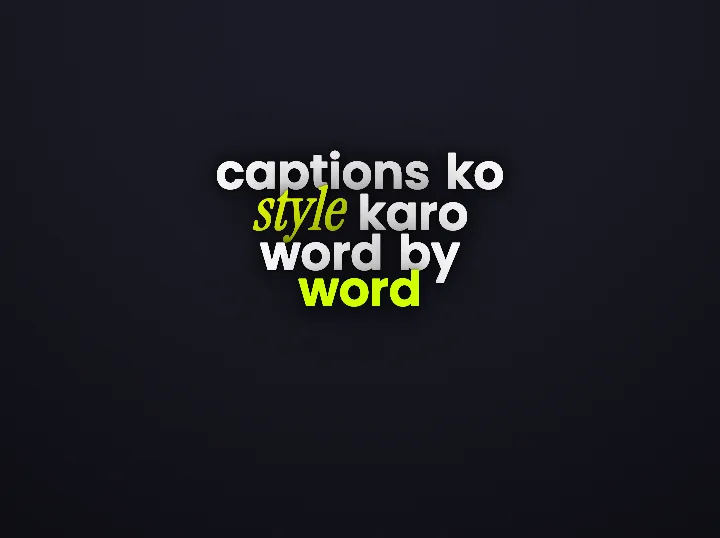
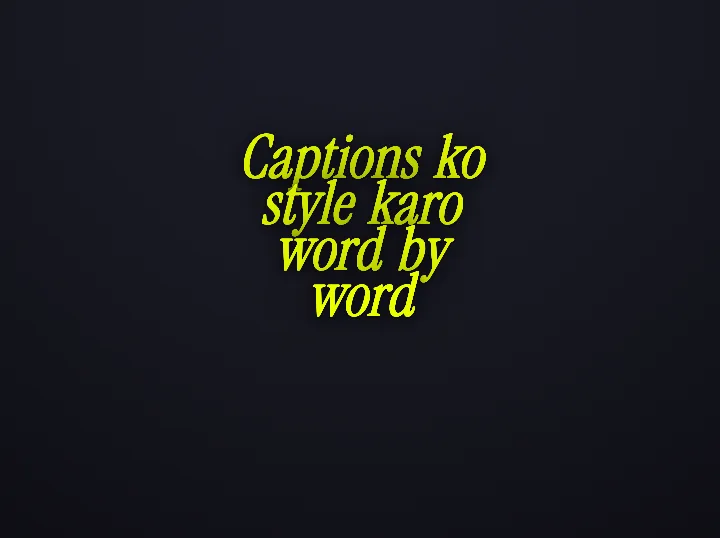
The constraint is volume, not craft
Many takes, same treatment
A creator sends five hooks against one body. Set the reel style once and the whole cut inherits it; only the beats you deliberately change differ.
Product names spelled right
Brand and product names are exactly what a transcriber mangles. Fix the word inline; the timing of every other word stays where it was.
Creators who code-switch
Hindi–English delivery is normal in Indian UGC and it is where most caption tools fall apart. Word-level timing works on code-mix, in Roman script.
What Headroom is not doing here
It does not find the clip inside a longer take, generate ad variants, connect to an ad account, or tell you which hook performed better. It has no view of your campaign at all.
It handles the caption and typography pass on a cut you have already chosen — which, on a week where you are shipping fifteen of them, is most of the manual work.
Questions
Should UGC ads use bold animated captions at all?
On the hook and the proof, yes. Across the whole ad, usually not: heavy captions signal “produced”, and the format’s advantage is looking like a real person’s video. Two treatments in one ad is the common shape.
Can I animate a price or a discount figure?
If it is a whole number, yes — Count up runs a number up to its value while it is on screen, including with a currency symbol. It deliberately does not offer itself on decimals, ranges or percentages with a decimal point, because there is no honest count for those.
Will the captions get cut off in the ad placement?
Only if they sit where the platform draws its own interface. Caption position is per-caption and can be dragged, which is covered on caption placement.
Can I test this on a real ad before paying?
Yes. Export 10 minutes of video free with five free caption themes from a desktop browser. Clean AI Edits, layers, and full editing are included; other themes, Behind captions, and Balanced or High Energy AI Edits require a paid export. Videos can be up to 6 minutes each, and re-exporting a video you already made never counts again. It is a one time allowance rather than a monthly one. Paid plans add fresh minutes every month and longer videos. Plans are on pricing.
Keep going
Run it on one cut first
Upload an ad you have already shipped and treat the hook and the number differently from the rest.